Lewis-Skelly vs Zubimendi: Henry Backs Arsenal Teenager for Atletico Madrid Clash

Arteta Faces Midfield Call as Lewis-Skelly Pushes for Champions League Start
Mikel Arteta has a decision to make, and it’s not quite the straightforward one many expected a week ago.
Arsenal return to the Emirates with their Champions League semi-final finely poised after a 1-1 draw away to Atletico Madrid. On paper, the selection in midfield seemed settled long before the weekend.
Martín Zubimendi, signed to bring control and calm, had been a near-automatic pick for nights like this.
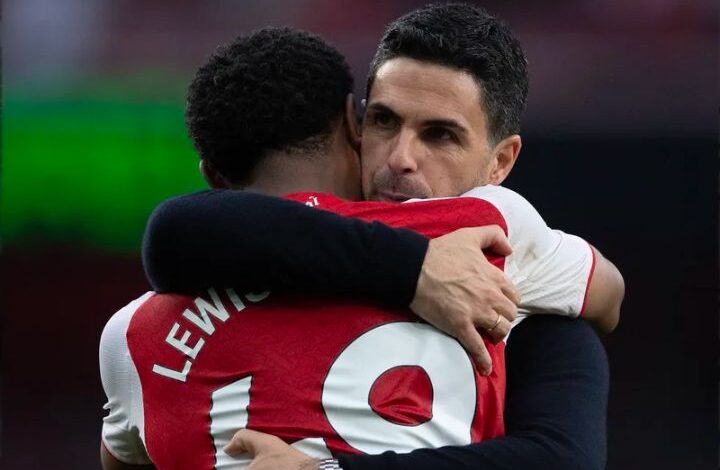
Then Myles Lewis-Skelly stepped in against Fulham and quietly complicated things.
The teenager, making just his third Premier League start and deployed in an unfamiliar defensive midfield role, didn’t just fill in. He took hold of the game.
A performance that changed the conversation
There’s patience, and then there’s readiness. The two don’t always go hand in hand, especially with young players waiting for their chance. But Lewis-Skelly looked like someone who had been preparing for this moment for a while.
Thierry Henry certainly saw it that way, noting after the game: “Not only that, he was ready. It’s one thing to be patient. It’s one thing to maybe be upset about the situation, but he was ready.”
What stood out wasn’t just composure, but authority. He didn’t play like someone easing himself into the occasion. He dictated it at times.
Henry added: “He didn’t look like he didn’t play for a very long time. He controlled the game. He went forward. He bossed the game at times. That’s outstanding.”
That kind of performance doesn’t go unnoticed, especially not with a European semi-final on the horizon.
Experience vs instinct
Arteta now finds himself weighing two very different profiles. On one side, Zubimendi, experienced, positionally disciplined, and trusted for much of the season. On the other, a teenager offering energy, anticipation, and a willingness to play on the front foot.
Henry didn’t dismiss the importance of experience, particularly at this stage of the competition, but even he couldn’t ignore what he had just watched.
“Do not underestimate experience in this type of games, but would I like to see him in [the team] tomorrow? Obviously, yes, why not? But Mikel Arteta is the coach,” he said.
There was also a subtle comparison that said plenty. “Like everybody, I thought Declan [Rice] was outstanding once again, but Myles [Lewis-Skelly] was just different.”
Different can be a powerful word in football. Sometimes it’s exactly what shifts a tie.
The moment that summed him up
One passage of play against Fulham seemed to capture everything Lewis-Skelly brings. It wasn’t flashy, but it was sharp, instinctive, and decisive.
Henry broke it down in detail: “Here he turns a counter into a counter. He sees that Declan Rice is going with this player and he says ‘I need to intercept that ball’ because if that ball goes to Smith Rowe, you have a 4v4.
Now he intercepts the ball and the next swing [he gets Arsenal going forward]. That’s what great players do, you stop a counter, and you make it a counter.”
It’s the kind of awareness you can’t always teach. Spotting danger early, acting on it, and then immediately flipping the direction of play. For a player so new to the role, it raised eyebrows for the right reasons.
A shift in Arsenal’s rhythm
Gary Lineker also leaned toward the younger option, suggesting Arsenal’s overall approach looked sharper without Zubimendi’s more conservative style.
“I’m going to throw something in here because I think there’s a fundamental difference between the Arsenal that we’ve seen in recent weeks,” he said.
He went on to explain: “No disrespect to Zubimendi, but he’s a cautious player. He’s a defensive midfield player and he predominantly knocks it back.”
That caution has its place, especially in tight European ties, but Lineker felt Lewis-Skelly brought something Arsenal had been missing.
“I thought Myles Lewis-Skelly came in in a midfield position, not a left-back that’s moving into midfield. His first thought is to turn and look forward and quickly.”
That intent to move play forward had a knock-on effect across the pitch.
“I think that really enabled Arsenal to get it forward quicker. It was a bit of a plan, they pushed the wingers higher. Saka was getting the ball in time to take someone on. I think he made a fundamental difference.”
Sometimes, it only takes one player to subtly alter the tempo of an entire team.
This isn’t just about one good performance versus a dip in form. It’s about balance, risk, and what Arsenal need on the night.
Zubimendi offers control and familiarity. Lewis-Skelly offers energy and unpredictability.
Against an Atletico Madrid side known for discipline and structure, there’s an argument for both. Do you match their caution, or try to disrupt it?
Arteta has trusted experience before in big moments. But football has a habit of rewarding bold calls, especially when momentum is involved.
Lewis-Skelly has given him something to think about. And not just for the future, but right now.